
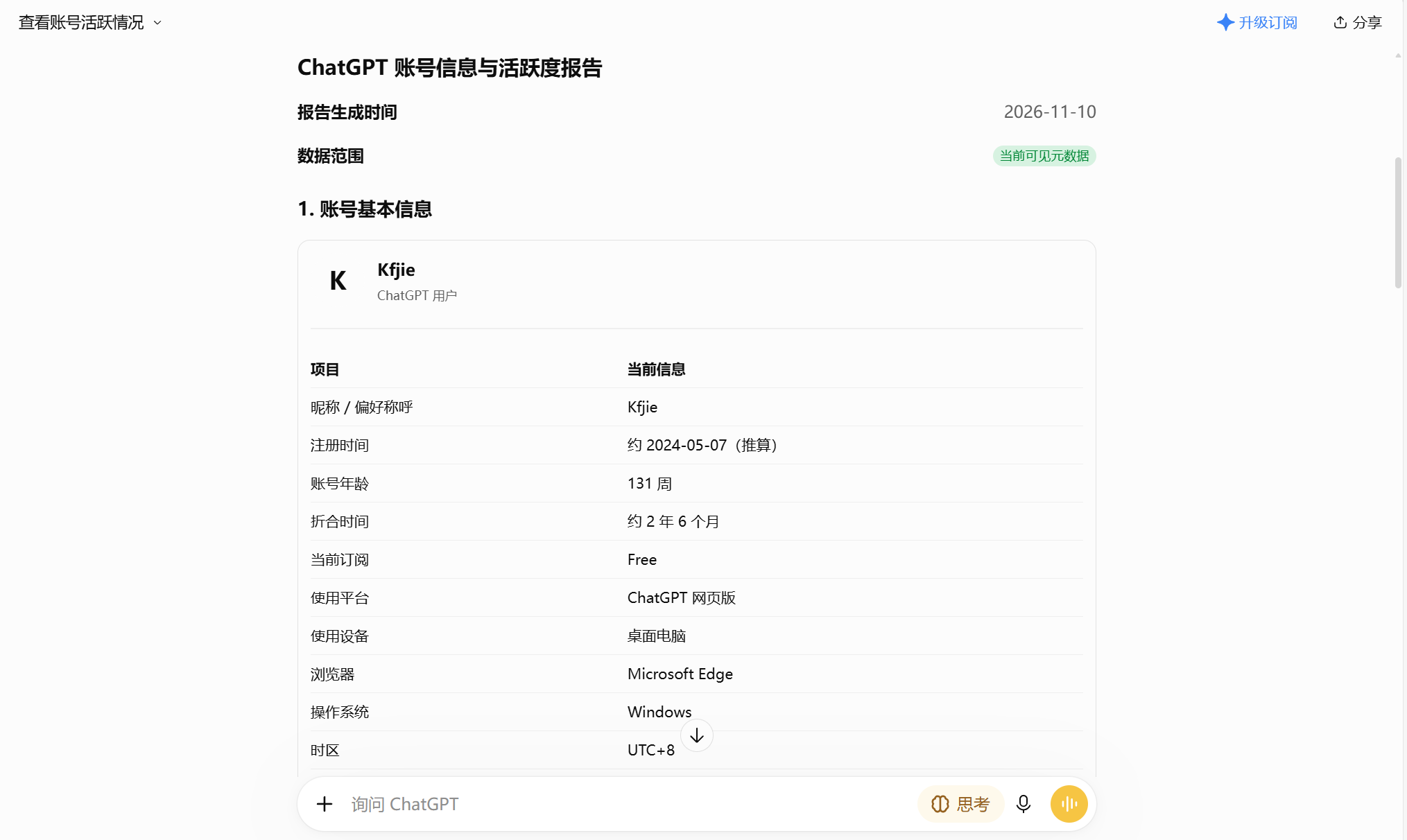
It’s been a year since ChatGPT was officially launched, and today marks the one-year anniversary of this main account’s creation. It’s such a relief that my IP address keeps changing and I haven’t been banned yet!
It’s been two and a half years since I first signed up for ChatGPT, and it really makes me reflect. I think it was already version 4.0 back then, right? I just remember that there was already a subscription system in place. Since I couldn’t afford a subscription, I was limited to uploading only five attachments at a time. It might have been fewer or more—I don’t really remember.
It’s been over three years since I first used ChatGPT, hasn’t it? I think I was using it on a public chat platform back then. Was it still version 3.5? I remember holding my phone and feeding it the last writing prompt from my English exam—probably the subject I hated the most at the time—and asking it to generate an essay.
I watched as it churned out words one by one, forming strange, inexplicable words that coalesced into sentences, and then those sentences coalesced into a rather wondrous little piece of writing. It couldn’t guarantee semantic coherence, nor did it meet the requirements of so-called high-scoring essay templates. All it could do was give me an essay; as for what that essay was like, I just had to let it be.
At that moment, it felt like I’d gotten my hands on a really fun toy—this is the world of probability, where everything is made up of probability.
Actually, it really makes me feel nostalgic. Back in my freshman year, I really liked using Kimi, and even now I still think Kimi is very useful, It’s just that he doesn’t give it to the poor anymore.。
Even compared to today, the language style of large language models at that time was likely not far behind. Or rather, the writing style of models at that time was actually quite good. It’s just that their contextual understanding, intelligence, and agent capabilities lagged behind today’s standards. At that time, Kimi was marketing itself specifically on its ability to handle long contexts.
At this point, none of the other models can beat me on the exam… right? At least with some of the answers, I can tell right away that something’s off hhh.
But so much has changed in recent years—everything has changed. Overall, the capabilities of large language models have absolutely doubled over the past year.
Large language models have evolved from their initial state as unstable probabilistic machines into relatively stable probabilistic machines. As for just how stable they are, they’ve actually outperformed the vast majority of their counterparts. They’re hardworking and capable; as long as upstream services don’t deliberately limit their capabilities, their performance will absolutely surpass that of the vast majority.
Over the past year, the intelligence of large language models has doubled, and their ability to use tools has improved. They have moved beyond web chat windows and taken over the world on the screen. As for when they’ll be able to reliably take control of external devices directly from the screen—I think it will happen in a few years, or perhaps even sooner.
Looking at the evolutionary series of a model, its lifespan is becoming increasingly shorter, with new models quickly taking its place. General-purpose models are also becoming larger in scale. Within a model’s series, the focus has shifted from the initial emphasis on chat functionality to the current specialization in agent coding capabilities.
Their speech is becoming increasingly rigid and formulaic, with a strong “AI” flavor to it. Maybe that’s a good thing—at least we can tell the difference.
Every development has two sides: there are always those who lead the way, and those who take a more conservative approach. Is this an era of a fleeting technological explosion unique to humanity? Or is it the beginning of the future?
We hope that the future we envision has already arrived, and we hope that everyone will benefit from this progress.
